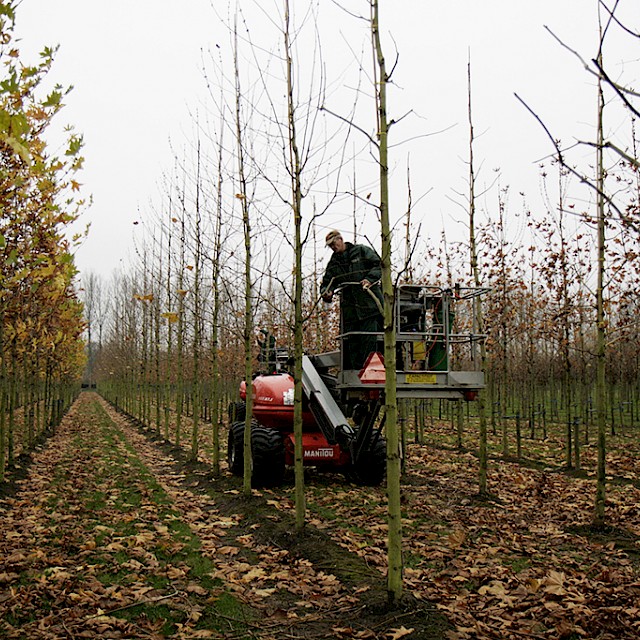
Preparation of the planting hole
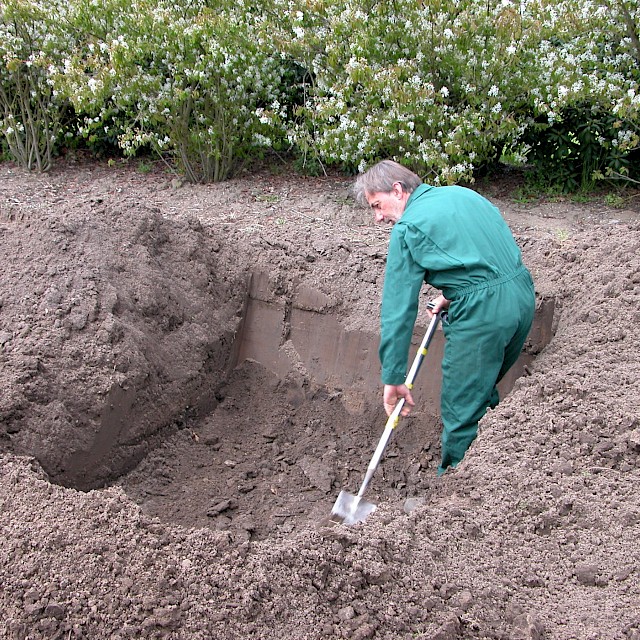
It is better if planting holes are ready the moment the trees arrive so that the trees do not have to spend any more time above ground than is strictly necessary. They must be dug under favourable weather conditions to avoid deterioration of the soil structure. In particular, heavy layers such as clay or loamy soils close quickly when dug during wet weather which leads to numerous problems as water will no longer be able to drain away. Moreover, glazing tends to form on the walls in clay and loamy soils making it hard for the roots to grow outside the planting holes. This can be prevented by digging with a toothed bucket or by manually loosening the walls with a spade.
If soil is replaced the new and existing soil must be mixed together at the bottom of the planting hole in order to prevent the formation of an impermeable layer in which water can pool. The planting hole needs to be dug spaciously. Planting holes can never be too wide but they can be too deep. It is very important that the tree is no deeper than it was at the nursery as the roots will be smothered. The root collar must remain visible so, before digging, measure the height of the root ball. Bear in mind the fact that heavy trees may sink under their own weight and that disturbed or replacement soil will settle. Sandy soils settle by about 10% and clay soil generally by 20%. In such cases, plant the tree slightly higher. Never dig deeper than the highest water table, because when fertile organic soil comes in contact with groundwater, anaerobic digestion will occur causing a lack of oxygen in the soil.
Root balls are usually wrapped in hessian with a wire mesh. In order to avoid the risk of breaking the root ball during manoeuvring, it is best not to remove this. It is sufficient to loosen the wire mesh and hessian around the trunk once the tree has been placed in the planting hole. Hessian decomposes underground fairly quickly and the wire mesh, made from preheated steel will oxidize and eventually disappear as well.
Anchoring
Newly planted trees must be anchored to protect them from the wind. A tree is usually stable enough within 2 to 3 years, after which it no longer needs any extra help. There are various anchoring methods. The choice of anchoring depends in the size of tree, the size and quality of the root ball and the site where the tree is to be placed.
Above-ground high anchoring
Trees without a root ball always need above-ground, high anchoring. Lighter trees with a root ball are usually anchored above ground too.
• < 10-12 stem girth, 1 stake. Place the stake at the side where most wind comes from.
• > 10-12 stem girth, at least 2 stakes.
• > 25-30 stem girth, 3 stakes in a triangle around the tree.
Normally, tree stakes stand 1.5 metres above ground and 1 metre below ground. The tree stakes must be driven at least 20 cm into undisturbed soil, so if you have dug deep, you will need to use longer stakes. With lighter trees, the length of the tree stakes visible above ground may not exceed half the total height of the tree. With heavier trees, the stakes may not exceed a third of the total height. It is not necessary to preserve anchoring stakes. Ordinary stakes will last around 3 years on average, after which they may be removed.
Above-ground low anchoring
Good quality trees have a sturdy, solid root ball and can also be anchored with 2 or 3 low stakes. This method allows the tree to take root better and it is generally agreed that trees are sooner able to stand independently if they are anchored low down. This happens because the wind still rocks trees with low stakes which encourages it to produce new roots, and it also has the effect of stimulating the trunk to grow in thickness. The major drawback is that a lever effect can be exerted on the trunk and it can break off more easily.
Underground anchoring
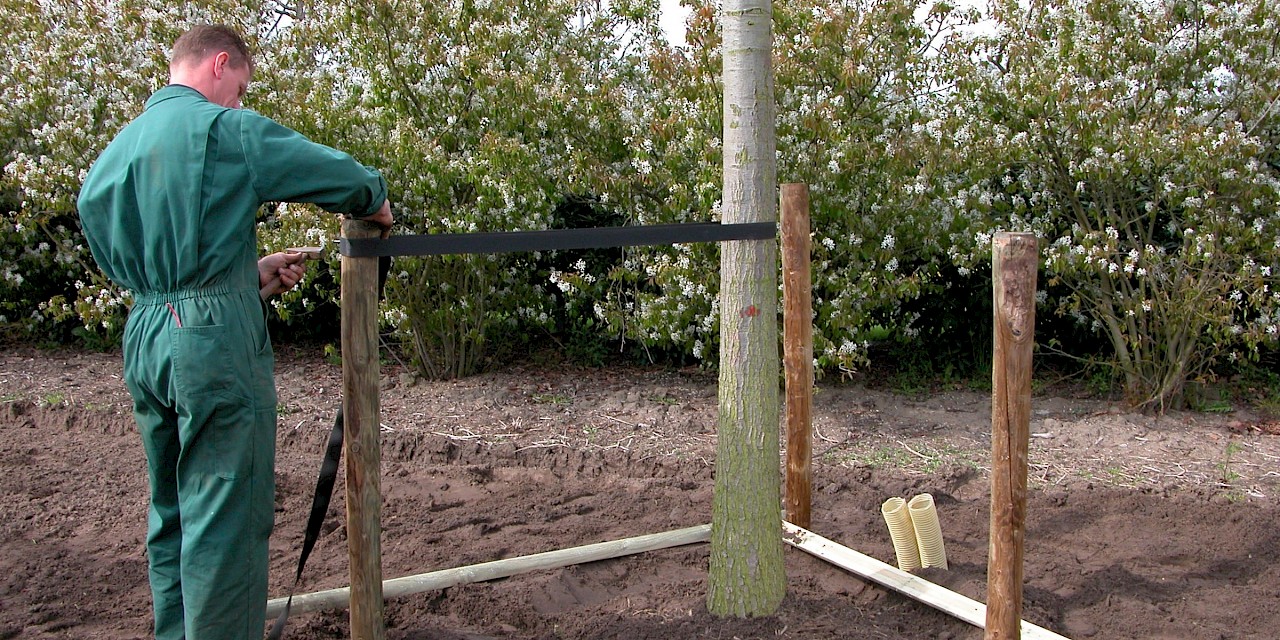
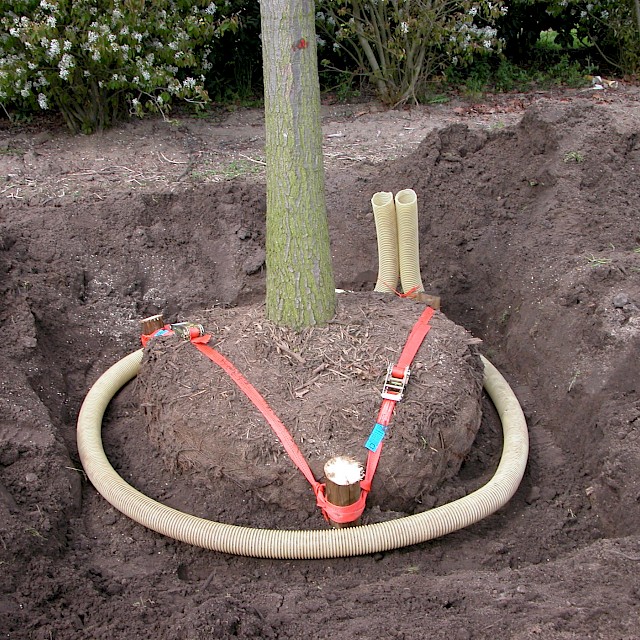
Underground achoring is only applicable to trees that have a large, compact root ball. This method is often selected for aesthetic reasons. Sometimes it is chosen for practical reasons, for instance when a tree is planted on a pavement or a tree grate needs to be put in place. For underground anchoring, three equally spaced stakes are driven into the ground around the root ball. Alternatively, earth anchors or concrete mesh are placed at the bottom of the planting hole. Then, by laying a strap or steel cable over the root ball, attaching it to the stakes and tightening it up, the tree is anchored. A drawback of this anchoring system is that it is not usually removed and the trunk base may eventually grow around the straps or cables. There are, however, biodegradable anchoring straps available which are preferable, if only for this reason.
Aeration and irrigation system
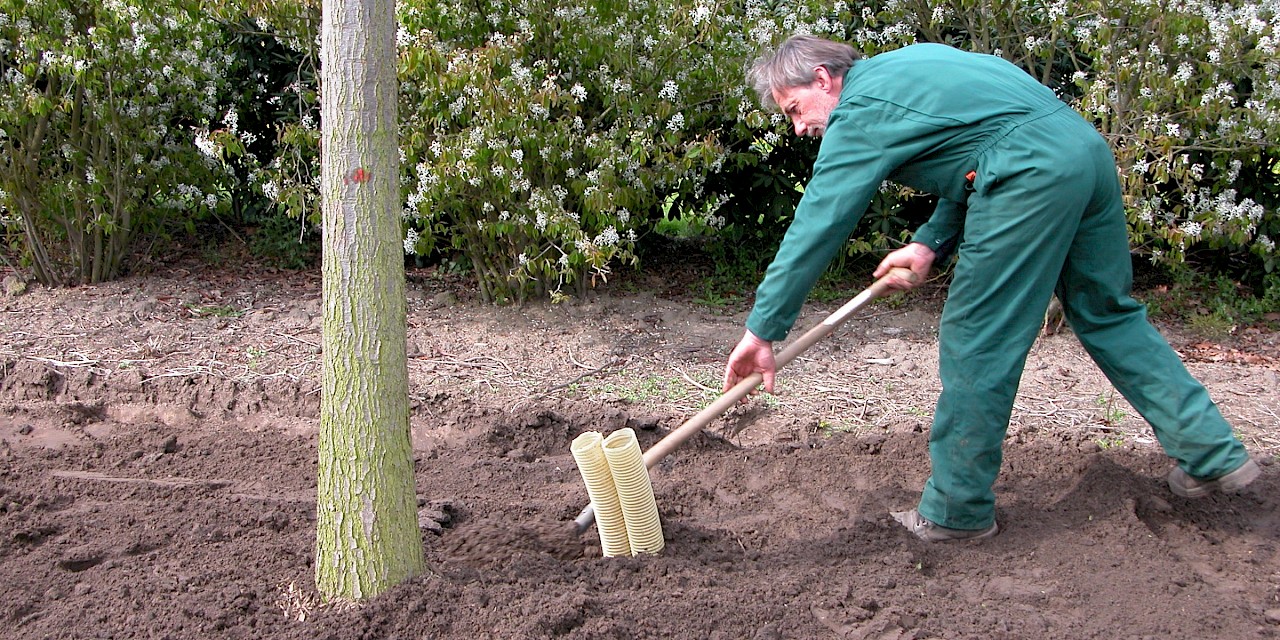
New roots require oxygen to be able to grow from the root ball. In principle, trees in open ground do not need any help with this unlike trees planted in paving. There are various aeration systems available and the extra perforated drainage pipe has turned out to be the most effective. It is laid around the root ball at around half its depth, and preferably slightly deeper. As a rule, an aeration system is important for 2 years at most, after which it is superfluous. In practice, the drainage pipe is often also used for irrigation but this is not recommended because in order to ensure that water can reach the entire root ball, an irrigation system needs to be installed as high as possible. A watering reservoir in which water can be buffered has so far proven to be the most effective way. This may consist of a wall of earth or a plastic barrier around the trunk. If you do not like how this looks, you can still use an extra drainage pipe, which needs to be placed as high as possible in the soil.
Take care not to create a glaze above the root ball when watering. This can quite easily occur with fatter soils, but is preventable either by regularly loosening the soil above the root ball with a shovel or cultivator or filling the watering reservoir with organic matter such as bark or wood chips.
Backfilling
Once the tree anchoring and any aeration and irrigation systems have been installed, the planting hole can be filled in. It is important that the roots make good contact with the soil around the root ball. Root balls are sometimes soaked to ensure that the planting hole is properly filled and there are no empty spaces alongside the roots.
If new soil is being used for backfilling, it is better to choose a soil type that is close to the original soil, supplemented with organic matter where necessary. If using good quality earth containing enough organic matter and soil organisms, then nothing extra needs to be added to the soil. If you are using fertilisers then organically based ones are preferable as they do not have an adverse effect on the soil organisms.
If you have any doubts about the presence of sufficient soil organisms then it is advisable to add microbes to the soil. There are various products on the market, although not all of them are efficient. It is above all important that the soil is inoculated with micro-organisms, as they form the basis of all soil life. Bacteria, single-cell organisms, nematodes and moulds stimulate the continued development of a healthy tree which means it will develop better and more quickly.
Pruning after planting
In healthy trees, there is a natural balance between crown and roots which is disturbed the moment they are replanted because every tree unavoidably loses part of its roots during digging up the tree. Consequently, the roots are unable to supply the crown with enough water, which causes stress. The tree responds by cutting the size and quantity of foliage in order to reduce the surface area of leaves. If the water shortage is too great, the tree will even start to shed wood from the crown which risks affecting the habit. Irrigation is therefore essential for the first two years, but this alone is often not enough. During long warm periods, or when there are extremely high temperatures, it is possible that the foliage will dry out whilst the root ball is moist. There is simply not enough root capacity to supply the required amount of water to the crown. In such a case, giving the tree more water is not an option and will only have adverse consequences such as lack of oxygen and root rot. The only solution is to reduce the demand for water by pruning the tree, preferably right after planting so the trees do not suffer heavily in peak periods. In the first two years the crowns will have a reduced volume but the trees will suffer from less stress, they will take root more quickly and develop better.
Read the interview with Cees van Casteren, former production manager at Van den Berk Nurseries with 47 years experience in growing trees.
Pruning is done on the one or two-year old wood. The thick wood in the crown must remain intact as it contains food reserves that the tree needs in order to develop new roots. It is not necessary to prune all the one and two-year old wood from the tree. Trees with lots of wood in the crown need pruning radically but trees without much wood in the crown, e.g. Ailanthus require minimal pruning. In order not to damage the habit of the tree it is wise to keep the terminal buds and only remove lateral shoots.
Trunk protection to sunburn
Unfortunately, it is becoming more common; cracks on the trunk due to overheating. The flow of water in the trunk usually protects the bark cells against overheating, but after planting less water is transported to the crown and this cooling system does not work well enough. As a result the trunk risks getting sunburnt. The setting sun is the worst offender because it shines directly on the trunk and it can heat the cells up so much that they break. It is for this reason that sunburn is usually visible on the west side of the tree.
In particular, trees with a smooth and thin bark are very vulnerable and need protection, which can be afforded by wrapping the trunk in cocofibre or reed mats. Trees with a rough bark and those which are branched down to their base are less vulnerable and usually need no protection.
Attention: wrapping hessian around the trunk often used to be done but experience has taught that this can have adverse effects because the hessian can get tight and the bark may start to fester beneath it. The temperature can then rise considerably causing damage to the bark and the rest of the tree.

 English
 English (United Kingdom)
 Nederlands
 Nederlands (België)
 Deutsch
 français
 čeština
 polski
 español
 română
 dansk
dansk
 svenska
 magyar
 Türkçe
 slovenčina
 русский
 norsk
norsk